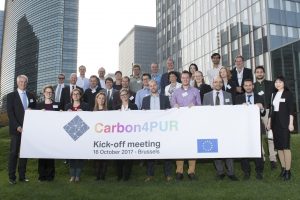
Europeans join forces on CO2
Research project launched with 14 partners from seven countries EU supports development of a particularly sustainable process


Research project launched with 14 partners from seven countries
EU supports development of a particularly sustainable process
The use of carbon dioxide and other waste gases as a new source of raw materials is increasingly a topic of interest at the European level. A new
consortium of 14 partners from seven countries, led by materials manufacturer
Covestro, is now planning to investigate how flue gas from the steel industry can
be used to produce plastics in a particularly efficient and sustainable way. This
will save crude oil, the raw material used in conventional methods. The crosssector
project called Carbon4PUR receives funding from the European Union.
“Together, we are on the path to a crucial innovation: waste gas mixtures from
the steel industry can provide carbon for a chemical processes and ultimately be
used to produce insulation materials and coatings,” explained Dr. Markus
Steilemann, the Covestro Board Member responsible for Innovation, Marketing
and Sales. “This helps us to broaden our resource base and to reduce the
climate footprint for the entire value chain. At the same time, we are joining our
forces by partnering with industrial and academic partners throughout Europe.”
Cooperation across borders
The new project introduces an unprecedented cooperation extending from the
waste gas source to the plastics manufacturer. The European Union is
supporting Carbon4PUR under the auspices of SPIRE, the European Public-
Private Partnership, dedicated to innovation in resource and energy efficiency
enabled by the process industries. About eight million euros are provided f
time of three years. The industrial partners will leverage this contribution by
further investments.
Specifically, the project aims to use mixtures of carbon dioxide and carbon
monoxide, which are generated during steel production, to produce polyols –
key components of polyurethane-based insulating materials and coatings that
are otherwise obtained from crude oil.
Significantly smaller carbon footprint
The process being developed is special because it eliminates the resource
intensive step of separating the waste gas into its different components. Instead,
the gas mixture will be subjected to a chemocatalytic process and converted
directly into building blocks and intermediates for polyurethanes. This can
reduce its carbon footprint by 20 to 60 percent.
The ideal starting conditions for the industrial pilot project already exist: in the
southern French town of Fos-sur-Mer, an ArcelorMittal steel factory and a
Covestro production facility are close neighbours. The gas recovery project
consortium includes academic and institutional partners such as RWTH Aachen
University, TU Berlin, Dechema, Imperial College London, the universities of
Gent and Leiden, the French Commissariat à l’énergie atomique et aux énergies
alternatives, South Pole Carbon Asset Management, Grand Port Maritime de
Marseille and PNO Innovatieadvies. From its base in southern France, Covestro
could deliver its innovative intermediate products to additional industrial
partners, such as Recticel, a Belgium-based polyurethane foam manufacturer,
and Megara Resins, a Greek supplier to the coatings industry.
Last year, Covestro began using carbon dioxide to produce a precursor for soft
polyurethane foam, which is designed for use in upholstered furniture and
mattresses. Meanwhile, the company is researching additional areas of
application for CO2-based raw materials.
About Covestro:
With 2016 sales of EUR 11.9 billion, Covestro is among the world’s largest
polymer companies. Business activities are focused on the manufacture of hightech
polymer materials and the development of innovative solutions for products
used in many areas of daily life. The main segments served are the automotive,
construction, wood processing and furniture, and electrical and electronics
industries. Other sectors include sports and leisure, cosmetics, health and the
chemical industry itself. Covestro has 30 production sites worldwide and
employs approximately 15,600 people (calculated as full-time equivalents) at the
end of 2016.
materials is increasingly a topic of interest at the European level. A new
consortium of 14 partners from seven countries, led by materials manufacturer
Covestro, is now planning to investigate how flue gas from the steel industry can
be used to produce plastics in a particularly efficient and sustainable way. This
will save crude oil, the raw material used in conventional methods. The crosssector
project called Carbon4PUR receives funding from the European Union.
“Together, we are on the path to a crucial innovation: waste gas mixtures from
the steel industry can provide carbon for a chemical processes and ultimately be
used to produce insulation materials and coatings,” explained Dr. Markus
Steilemann, the Covestro Board Member responsible for Innovation, Marketing
and Sales. “This helps us to broaden our resource base and to reduce the
climate footprint for the entire value chain. At the same time, we are joining our
forces by partnering with industrial and academic partners throughout Europe.”
Cooperation across borders
The new project introduces an unprecedented cooperation extending from the
waste gas source to the plastics manufacturer. The European Union is
supporting Carbon4PUR under the auspices of SPIRE, the European Public-
Private Partnership, dedicated to innovation in resource and energy efficiency
enabled by the process industries. About eight million euros are provided f
time of three years. The industrial partners will leverage this contribution by
further investments.
Specifically, the project aims to use mixtures of carbon dioxide and carbon
monoxide, which are generated during steel production, to produce polyols –
key components of polyurethane-based insulating materials and coatings that
are otherwise obtained from crude oil.
Significantly smaller carbon footprint
The process being developed is special because it eliminates the resource
intensive step of separating the waste gas into its different components. Instead,
the gas mixture will be subjected to a chemocatalytic process and converted
directly into building blocks and intermediates for polyurethanes. This can
reduce its carbon footprint by 20 to 60 percent.
The ideal starting conditions for the industrial pilot project already exist: in the
southern French town of Fos-sur-Mer, an ArcelorMittal steel factory and a
Covestro production facility are close neighbours. The gas recovery project
consortium includes academic and institutional partners such as RWTH Aachen
University, TU Berlin, Dechema, Imperial College London, the universities of
Gent and Leiden, the French Commissariat à l’énergie atomique et aux énergies
alternatives, South Pole Carbon Asset Management, Grand Port Maritime de
Marseille and PNO Innovatieadvies. From its base in southern France, Covestro
could deliver its innovative intermediate products to additional industrial
partners, such as Recticel, a Belgium-based polyurethane foam manufacturer,
and Megara Resins, a Greek supplier to the coatings industry.
Last year, Covestro began using carbon dioxide to produce a precursor for soft
polyurethane foam, which is designed for use in upholstered furniture and
mattresses. Meanwhile, the company is researching additional areas of
application for CO2-based raw materials.
About Covestro:
With 2016 sales of EUR 11.9 billion, Covestro is among the world’s largest
polymer companies. Business activities are focused on the manufacture of hightech
polymer materials and the development of innovative solutions for products
used in many areas of daily life. The main segments served are the automotive,
construction, wood processing and furniture, and electrical and electronics
industries. Other sectors include sports and leisure, cosmetics, health and the
chemical industry itself. Covestro has 30 production sites worldwide and
employs approximately 15,600 people (calculated as full-time equivalents) at the
end of 2016.
Related Posts